What Is OpenClaw AI?
Artificial Intelligence has evolved rapidly in recent years. In the past, AI systems were mostly limited to chatbots that answered questions or generated text. Today, a new generation of AI technology is emerging: AI agents that can perform tasks autonomously.
One of the most talked-about technologies in this category is OpenClaw AI.
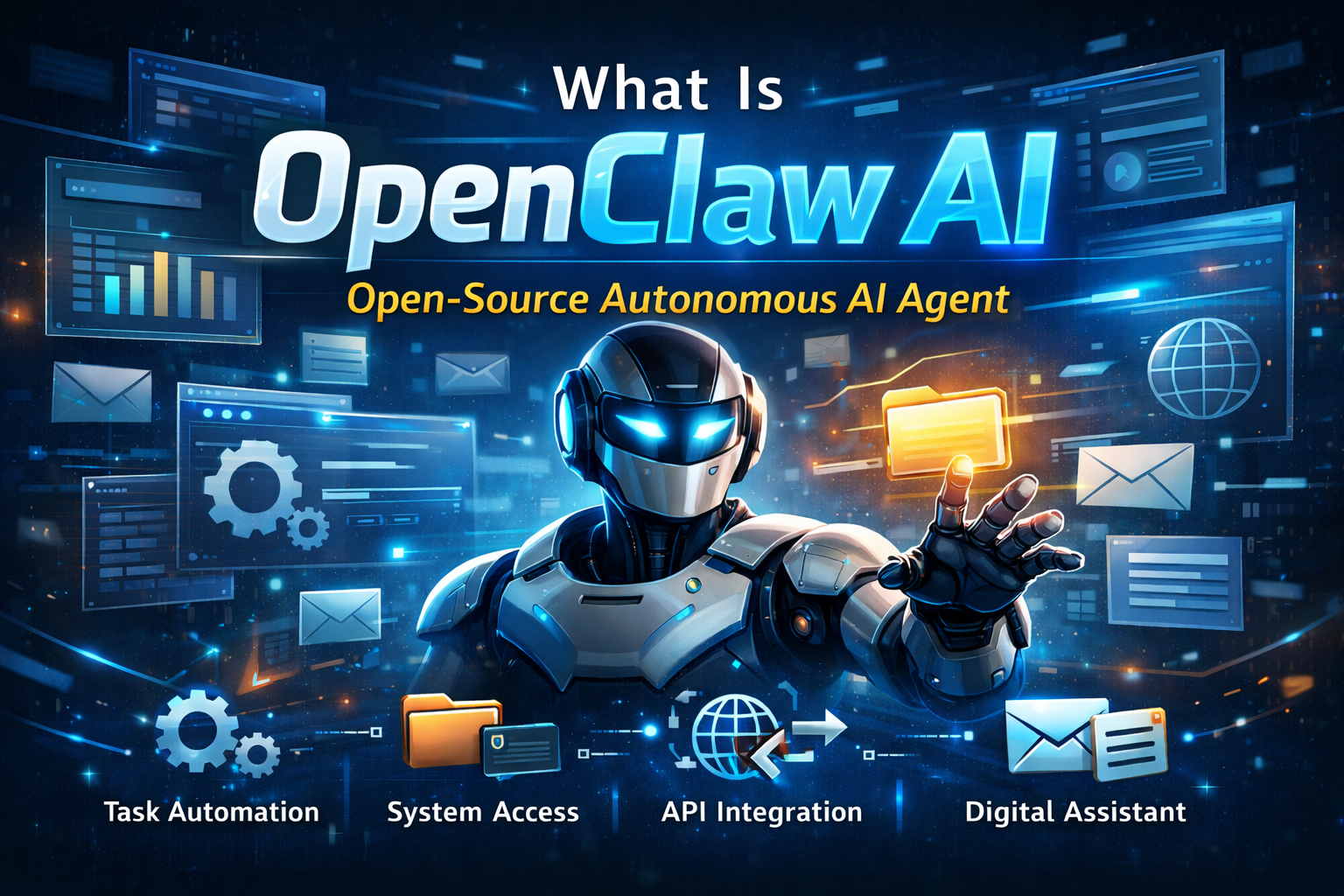
OpenClaw AI is an open-source AI agent framework that allows developers and users to create autonomous digital assistants capable of performing tasks on a computer or across the internet.
Unlike traditional chatbots that only respond to prompts, OpenClaw can:
- control applications
- access files
- automate workflows
- interact with APIs
- perform digital tasks automatically
Because of these capabilities, many experts consider OpenClaw a step toward fully autonomous digital assistants.
Why OpenClaw AI Is Gaining Attention
OpenClaw AI quickly became popular in the developer community because it represents a major shift in how AI is used.
Instead of simply generating responses, OpenClaw enables AI to take action.
Here are several reasons why the technology is gaining attention:
1. Open-Source Technology
OpenClaw is open source, which means anyone can download, modify, and improve it. This encourages rapid innovation and experimentation.
2. AI Agent Concept
OpenClaw introduces the concept of AI agents—systems that can think, plan, and execute tasks.
3. Flexible Integrations
The framework can integrate with many tools and platforms such as:
- messaging apps
- APIs
- cloud services
- databases
- browsers
4. Automation Potential
OpenClaw can automate many digital tasks, making it useful for individuals, developers, and businesses.
Understanding the AI Agent Concept
To fully understand OpenClaw AI, it’s important to understand what an AI agent is.
An AI agent is a system that can:
- perceive its environment
- make decisions
- take actions
- achieve specific goals
Traditional chatbots only respond to input. AI agents go further by performing tasks in the digital environment.
Examples of AI agent tasks include:
- sending emails
- retrieving data from websites
- generating reports
- scheduling meetings
- managing workflows
OpenClaw provides the infrastructure needed to build these types of systems.
How OpenClaw AI Works
OpenClaw AI works by combining several advanced technologies into a single framework.
These include:
- Large Language Models (LLMs)
- Autonomous agent architecture
- Tool integration systems
- Persistent memory systems
Let’s look at each component in more detail.
1. Large Language Models (LLMs)
OpenClaw uses Large Language Models as the “brain” of the AI system.
For example, models such as GPT-4 can analyze user instructions and determine how to complete tasks.
LLMs allow OpenClaw to:
- understand natural language
- interpret complex commands
- generate plans and strategies
These models make it possible for AI agents to communicate naturally with users.
2. Task Planning System
When a user gives a command, OpenClaw does not immediately perform a single action.
Instead, the AI agent follows several steps:
- Understand the user’s objective
- Break the objective into smaller tasks
- Select the tools needed
- Execute each step sequentially
For example, if a user asks the AI to create a daily business report, OpenClaw might:
- retrieve data from a database
- analyze the data
- generate a formatted report
- send the report via email
This structured workflow allows the AI to perform complex operations.
3. Tool Integration
One of OpenClaw’s most powerful features is its tool integration system.
The AI agent can use external tools to complete tasks.
Examples include:
- internet browsers
- system commands
- APIs
- data processing tools
- automation scripts
Instead of being limited to conversation, the AI can interact directly with digital systems.
4. Memory System
OpenClaw also supports persistent memory, allowing the AI agent to store and recall important information.
The system can remember:
- previous interactions
- user preferences
- project details
- task history
This makes the AI assistant more personalized and efficient over time.
Key Features of OpenClaw AI
OpenClaw offers several powerful features that distinguish it from traditional AI systems.
1. Task Automation
OpenClaw can automate repetitive digital tasks such as:
- sending scheduled emails
- collecting online data
- generating reports
- managing documents
Automation can save significant time and effort.
2. Messaging Platform Integration
The system can integrate with popular messaging platforms, allowing users to interact with their AI agent through chat.
Examples include:
- Slack
- Discord
- Telegram
This makes the AI assistant accessible anywhere.
3. Computer System Access
OpenClaw agents can access the user’s computer environment.
They can:
- read and write files
- execute scripts
- control applications
This capability allows AI to perform tasks that typically require manual work.
4. Workflow Automation
Businesses can use OpenClaw to automate complex workflows such as:
- data analysis
- marketing automation
- project management
- customer support processes
This makes the technology attractive for startups and enterprises alike.
Real-World Use Cases of OpenClaw AI
OpenClaw can be applied in many real-world scenarios.
1. Personal AI Assistant
Users can create AI assistants that help with daily digital tasks such as:
- managing calendars
- setting reminders
- organizing files
- sending messages
2. Business Automation
Companies can use OpenClaw to automate business processes such as:
- customer support responses
- report generation
- market research
- data monitoring
Automation reduces workload and improves efficiency.
3. Software Development Support
Developers can also use OpenClaw to assist with programming tasks such as:
- generating code
- running automated tests
- debugging scripts
- managing repositories
4. AI Research
Researchers can experiment with OpenClaw to study:
- multi-agent systems
- AI collaboration
- autonomous decision-making
These experiments help advance the field of artificial intelligence.
Advantages of OpenClaw AI
OpenClaw offers several benefits compared to traditional AI tools.
Open-Source Development
Because OpenClaw is open source, developers can freely modify and improve the system.
Highly Flexible
The framework can be adapted for personal use, research, or enterprise applications.
Extensive Integration
OpenClaw can connect to many external systems through APIs and plugins.
Powerful Automation
The ability to automate complex workflows is one of the technology’s biggest strengths.
Challenges and Risks
Despite its potential, OpenClaw AI also presents several challenges.
Security Risks
Because OpenClaw agents can access system resources, improper configuration could expose sensitive data.
Potential risks include:
- data leaks
- unauthorized system access
- malicious scripts
Technical Complexity
Setting up OpenClaw may require technical knowledge, especially for configuring integrations and tools.
API Costs
If the system uses cloud-based AI models, users may need to pay for API usage.
The Future of OpenClaw AI
Many experts believe that technologies like OpenClaw represent the next stage of AI development.
Future AI agents may become:
- fully autonomous digital assistants
- AI coworkers in businesses
- automated research agents
- collaborative multi-AI systems
In the future, the internet itself may include networks of AI agents interacting with each other to complete complex tasks.
OpenClaw could be an early example of this transformation.
Conclusion
OpenClaw AI is an open-source AI agent framework that allows developers and users to create autonomous digital assistants capable of performing real digital tasks.
By combining Large Language Models, tool integrations, and automation systems, OpenClaw moves AI beyond simple conversation toward action-oriented intelligence.
Although challenges such as security and complexity still exist, the technology demonstrates how AI agents may reshape the future of work, productivity, and digital automation.
Understanding OpenClaw AI today provides valuable insight into the next generation of artificial intelligence systems.